

In the world of Revenue Operations, the ideal is a simple, elegant playbook. We’re driven to transform complex commercial needs and messy data into a streamlined process that just works. The ultimate goal? To free up our teams to excel at their core skills; selling, servicing, and creating, while the systems and automations take care of everything else in the background and ensure accurate reporting and insights.
After years of designing and implementing processes—some very successful, others valuable learning experiences, I’ve found that the most common mistake is a simple one: we chase efficiency too soon. We’re so eager to do things faster that we forget to first ensure we’re doing the right things in the first place.
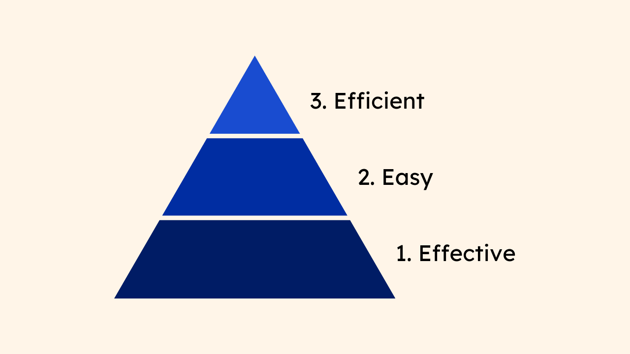
Think of it like a startup. You must achieve product-market fit before you pour millions into scaling sales and engineering. In process design, the principle is the same. We must find the most effective way to get results before we try to make it efficient. This simple three-phase approach helps us with building processes that not only work but last.
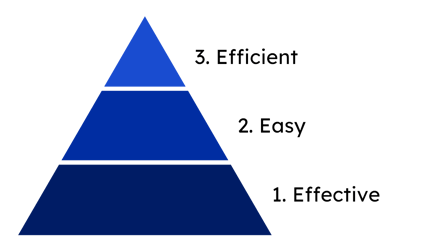
1. Effect: Uncover What Truly Moves the Needle
Before you optimize, you must discover. The first phase is all about identifying the core activities that produce your desired outcome. It’s not about doing things faster; it’s about doing the right things. The focus here is singular: what is the most effective method for achieving our primary goal?
Let's say your objective is to increase customer renewals. The "pure efficiency" mindset would lead you to find ways to send more renewal emails or make more check-in calls per day, without really confirming if more touchpoints even improve the key metric in the first place.
The "Effect before efficiency" mindset asks different questions:
-
Which actions have the most predictable and positive impact on a customer’s decision to renew?
-
Is it a quarterly business review with a senior stakeholder? A technical health check-in? Proactive outreach based on product usage data?
-
-
Which customer segments are most responsive to which type of engagement?
This phase is about experimentation. It’s about testing different approaches—combining high-touch strategic reviews with automated check-ins, to understand what works. Perhaps you discover that a personalized video message from the account manager has a far greater impact on renewal rates than ten automated emails. That discovery is your gold.
You’re not building the full assembly line yet; you’re perfecting the critical step that creates the value. Only once you’ve identified these key levers can you move forward.
2. Make It Easy: Pave the Road for Your Team
Once you know what works, the next challenge is ensuring your team can execute it consistently. An effective method that is too complex or confusing to follow is useless in practice. This phase is all about adoption and change management. Your goal is to make the effective methods easy to perform.
This is where systems, training, and thoughtful design come into play.
-
Simplify the Workflow: Build the process directly into the systems your team uses every day (like your CRM). Use guiderails, required fields, and automated alerts to guide them. The right path should be the path of least resistance.
-
Automate the Annoying Stuff: Automate data entry and activity logging wherever possible. If a salesperson has to spend ten minutes logging a call, they’ll find ways to avoid it. If the system logs it for them, they can focus on the conversation itself.
-
Train for "Why," Not Just "How": Your team needs to understand the purpose behind the process. When they see why capturing a specific piece of information leads to better outcomes, they become partners in the process, not just cogs in a machine.
A new team member should be able to step in, understand their role, and start contributing without needing to memorize a 100-page manual. When the process is intuitive and the value is clear, consistency follows.
3. Drive Efficiency: Optimize, Automate, and Scale
Now, and only now, do you get to do what most operations leaders love most: optimize everything. With an effective method in place and a team that follows it with ease, you have a stable foundation to build upon. This is the time to ask:
-
Where can we remove friction or save time?
-
What manual tasks can be automated without sacrificing quality?
-
How can we scale this process to handle 10x the volume?
This could involve anything from creating templated email responses for common inquiries to implementing a sophisticated lead scoring model that automates qualification for certain segments.
This phase is rarely "finished." It’s a continuous loop of improvement, adapting to new technologies, changing market conditions, and feedback from the team on the front lines. A high-performing process is a living process, one that is constantly being refined. By putting effect before efficiency, you ensure you’re not just growing faster, you are growing better.