
Churn is determined the moment a misaligned deal is signed

You're at your weekly leadership meeting. Numbers are up, but there’s tension in the air.
Theres a churn report on the table, and it does not look good.
The name of a recently canceled customer screams up from the page. The same “record-breaking” deal that had the sales team popping champagne just a few months ago.
Finger-pointing has already begun.
The sales team says Customer Success (CS) didn’t “manage the relationship well enough.” CS counters that the deal was doomed from the start.
Eventually, the truth surfaces.
The signed contract never addressed the core challenges the customer was facing. It was driven by heavy price negotiation to meet the quarterly sales target, not by true ROI or a shared vision of success.
Too many organizations first realize there’s a problem when the cancellation letter arrives.
Churn is often portrayed as an unpredictable storm that appears “out of nowhere.” But it’s frequently set in motion the moment a misaligned deal is signed.
Companies tend to blame churn on the Customer Success (CS) team or external market factors, yet the root cause often lies in a contract that was never truly aligned with the customer’s needs.
When the primary motivator for closing is pushing discounts or quota attainment instead of solving a genuine business problem, churn becomes almost inevitable.
By then it’s too late.
The best Customer Success team in the world can only do so much to salvage a partnership that started off on shaky foundations.
So businesses need to start looking at the pre-sale phase if they have a churn-problem.
That means crafting a solid business case, aligning on outcomes, and setting the stage for a long and mutually beneficial relationship.
Why the business case matters
A well-defined business case guides the entire customer journey. When you and your customer collaborate to build it together, you:
- Pinpoint the exact pain points or gaps in their operations
- Articulate the desired future state, establishing what success will look like
- Set quantifiable metrics, from reducing operational costs to accelerating time-to-value, that give everyone a clear target
As the relationship progresses, there is far less room for buyer’s remorse or sudden “surprises” about what the product can and cannot do. Instead, everyone remains focused on whether you’re on track to deliver the agreed-upon outcomes.
Additionally, having a precise business case builds trust, simplifies the buying process, and improves your sales velocity (more revenue moving through your sales pipeline leading to higher quota attainment).
How alignment drives retention
When companies shift their sales approach from “closing at any cost” to “closing on the right value,” everyone benefits.
Customer Success shifts from a reactive firefighting role to a proactive, strategic function.
Sales professionals are no longer just order-takers. They become consultants who deeply understand each prospect’s objectives.
And the leadership team, rather than scrambling to explain churn, can focus on sustainable growth.
Steps to avoid misaligned deals
1. Align sales and customer success on the business case
Before a contract is signed, ensure Sales and CS have collectively reviewed the pain points, success metrics, and timelines. Keep these details in a shared business case and key notes in the CRM, so there’s no confusion about what was promised.
As a bonus, the customer wont have to get the sense that they need to start from scratch explaining their business case when engaging with the CS team.
2. Tie sales compensation & promotion to customer profitability
While there is no perfect incentive model, it should always try to do three things:
- Create incentives to do high-value actions and achieve best-in-class results
- Maximize alignment between the customer, company, and sales rep
- Minimize the risk of unwanted behavior
Focusing solely on bringing in new business with no consideration to retention or fit does not solve for this.
I'd generally recommend the following structure
1. The rep will get their commission based on quota attainment (or share of collected gross revenue for service businesses)
2. If a client churns within a given period (e.g., 9 months), part- or full claw back of commission for this customer
3. Tie promotion levels to the average (e.g., trailing 9 months) retention rate. If below the threshold, the rep will stay on their current seniority level.
3. Prioritize ongoing customer collaboration
In the best of worlds, the sales team are aware of what drives long-term client success, and what makes the lift of the CS team better (or worse). The same goes for the CS team.
No great collaborative efforts comes from a one-sided focus on "what's in it for me".
Working with the CS team to uncover potential upsell- and cross-sell opportunities, referrals, and case studies is a win for everyone.
The best sales reps know how to leverage every part of the organization to create win-win situations and drive business results.
4. Incorporate a shared sales framework such as SPICED
Have you even had a situation with a company where you feel like you have to explain your situation and needs over and over again?
That's how most companies operate.
There is generally some sales framework that's used by the sales team (to a certain point). But I rarely see that marketing and CS teams use the same framework (or are aware of how the sales use it and where it's stored in the CRM).
An effective sales framework is one of the highest impact things you can implement, but thinking that it's a "sales only" thing will leave most of the benefit on the table.
Conclusion
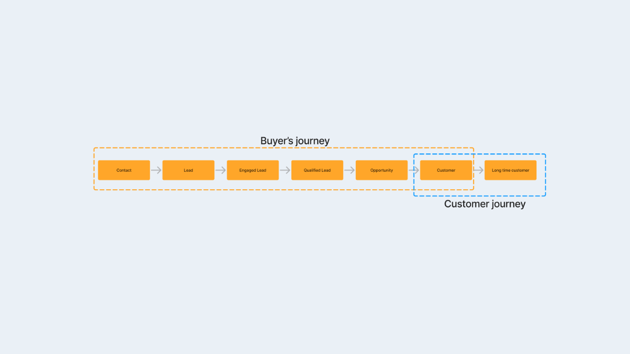
By taking the time to align on real business outcomes, you flip the script and anchor every stage of the customer journey in mutual value.
This means carefully assessing prospects’ needs, clarifying success criteria, and ensuring both Sales and CS are fully invested in delivering results. When that happens, renewals become the natural sequel to an already-successful story.